
For decades, yeshiva and day school tuition has functioned as an unofficial second mortgage for Orthodox Jewish families. A household paying $10,000, $20,000, or more per child per year in private school costs does so without meaningful federal support — a structural inequity that has defined communal life far more than any policy debate. That is about to change.
Within the One Big Beautiful Bill Act is a revolutionary provision that, if it works as intended, represents the most significant federal acknowledgment of private K–12 education costs in American history. Whether the funds actually reach the relevant families is a different question.
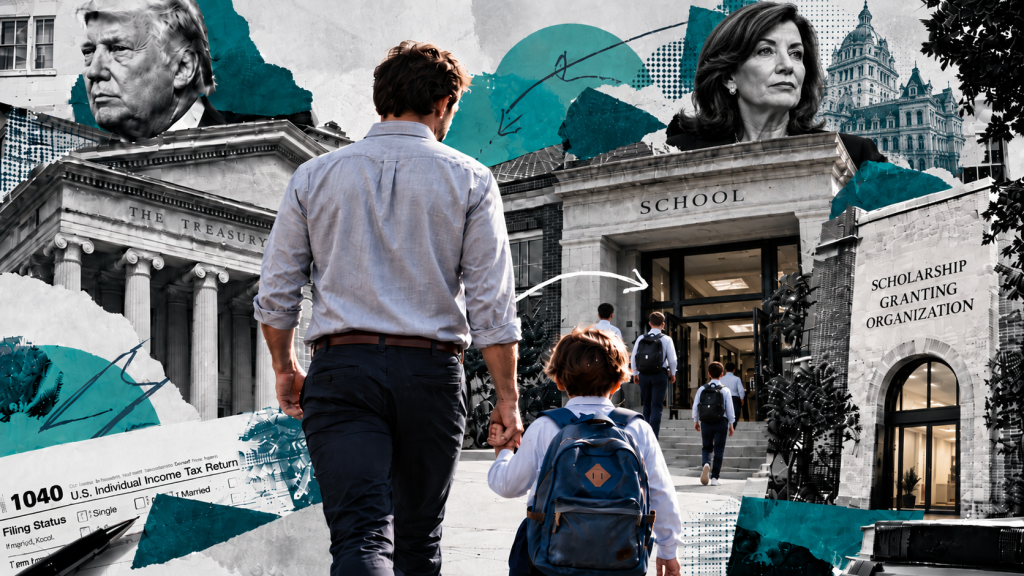
Section 25F of the OBBBA creates a new Federal Scholarship Tax Credit — administered through Scholarship Granting Organizations, or SGOs — effective January 1, 2027. The mechanism is straightforward: a taxpayer donates cash to a qualifying SGO, a 501(c)(3) nonprofit that awards scholarships to eligible K–12 students and receives a dollar-for-dollar reduction in federal income tax liability of up to $1,700 per return. This is not a credit for paying a family’s own tuition bill, rather the contribution goes to an SGO, and the SGO then distributes scholarship funds to eligible students according to its own award process and program rules.
For an SGO to qualify, it must spend at least 90 percent of its qualified contribution income on scholarships, serve ten or more students attending more than one school, maintain separate accounts with no co-mingling of funds, and verify that scholarship recipients come from households at or below 300 percent of area median income — a threshold that covers roughly 90 percent of K–12 students nationally. Eligible scholarship expenses include tuition, fees, tutoring, special needs services, curriculum, transportation, and technology. States must opt in and submit certified SGO lists to the IRS by January 1, 2027; 27 states have signed on, though New York — home to the largest concentration of yeshiva students in the country — has only signaled an intention to join. The Joint Committee on Taxation estimates the program will cost $25.9 billion over ten years, with no national cap on participation.
The architecture of the credit is genuinely sound. A well-functioning SGO could mobilize donor dollars from across a community — or across the country — and translate them into scholarship awards that reduce what families pay out of pocket. For a community already running its own tuition assistance infrastructure, this is not a foreign concept. It is, in effect, a federally subsidized version of what many communities have been building informally for years.
The problem is not the concept. The problem is a gap in the law that, left unaddressed, could cause a substantial portion of that benefit to be absorbed at the institutional level before it ever reaches a family’s bank account.
As new scholarship funding enters the system, schools may begin factoring that support into their annual budgeting. Even families that never interact directly with an SGO could feel the effects if tuition levels adjust around the availability of scholarship dollars. In that scenario, the family’s net out-of-pocket cost may not fall by much; instead, part of the federal benefit could be absorbed into the school’s broader revenue model. The Education Commission of the States has noted that the program’s overall impact remains uncertain, largely because state SGO rules and forthcoming Treasury Department guidance expected in July will shape how the program works in practice. That uncertainty leaves room for a key question: how much of the benefit will reach families directly, and how much will be absorbed by tuition-setting decisions?
This dynamic has a name and a forty-year track record. The Bennett Hypothesis — first articulated in the context of federally subsidized student loans — holds that when the federal government injects new money into a market with inelastic demand and limited supply, prices rise to absorb it. Higher education proved this across four decades: Pell Grants expanded, loan limits rose, and tuition climbed in near-perfect parallel, leaving families roughly where they started in real terms. The SGO program could create a similar pressure point for yeshiva tuition, though on a different scale and in a much shorter window. The concern is that new scholarship dollars may become part of the budgeting environment and influence how schools approach tuition decisions, even without dollar-for-dollar increases. Once that happens, tuition decisions may begin to reflect the availability of outside aid, leaving some families with less direct relief than the credit was designed to provide.
What better implementation looks like is not complicated, but it requires deliberate choices at multiple levels.
At the SGO level, organizations serious about the program’s integrity should adopt voluntary tuition-escalation guardrails as a condition of scholarship eligibility. That means that schools that raise tuition faster than a defined benchmark in a given year become ineligible to receive scholarship awards from that SGO for the following cycle. This is not punitive; it is simply aligning incentives. SGOs should also publish school-level award data annually so that donors, families, and community stakeholders can see where the money is actually going.
At the school level, boards should formally separate tuition-setting decisions from development and donor relations. If the same conversation that produces next year’s tuition number also includes a projection of expected SGO inflows, the institution is, functionally, pricing against the credit rather than for families. That is a governance failure, and it is one that sophisticated school boards can prevent by design.
At the state level, policymakers in the 27 states moving toward participation have a meaningful window before January 2027 to write SGO certification requirements that include price transparency standards. Requiring participating schools to disclose year-over-year tuition changes as a condition of their students’ SGO eligibility is a reasonable, administrable rule that does not restrict school autonomy — it simply creates accountability. Although, based on recent comments from Deputy Assistant Secretary for Tax Policy Kevin Salinger, states will not have the ability to impose these stricter standards for SGOs.
For donors thinking about the 2027 tax year, the groundwork starts now. Identifying well-governed SGOs — ones that serve genuinely broad student populations and publish their award data — is not difficult, but it requires asking questions that most donors have not needed to ask before.
The federal scholarship credit is a real policy achievement. For a community that has funded its own educational infrastructure largely without federal acknowledgment, the arrival of a dollar-for-dollar tax credit for private K–12 donations is not a small thing. The question is whether the community — its schools, its donors, its communal organizations — will build the implementation infrastructure that ensures the credit does what it says it does. The statute created an opportunity. The execution will determine whether it is an opportunity for families, or for institutions.
This material has been prepared for informational purposes only, and is not intended to provide or be relied upon for legal or tax advice. If you have any specific legal or tax questions regarding this content or related issues, please consult with your professional legal or tax advisor.