
Why your $300 ticket isn’t really a $300 ticket, how airlines turned miles into their most valuable asset, and what that tells us about why Spirit couldn’t stay airborne.
Executive summary
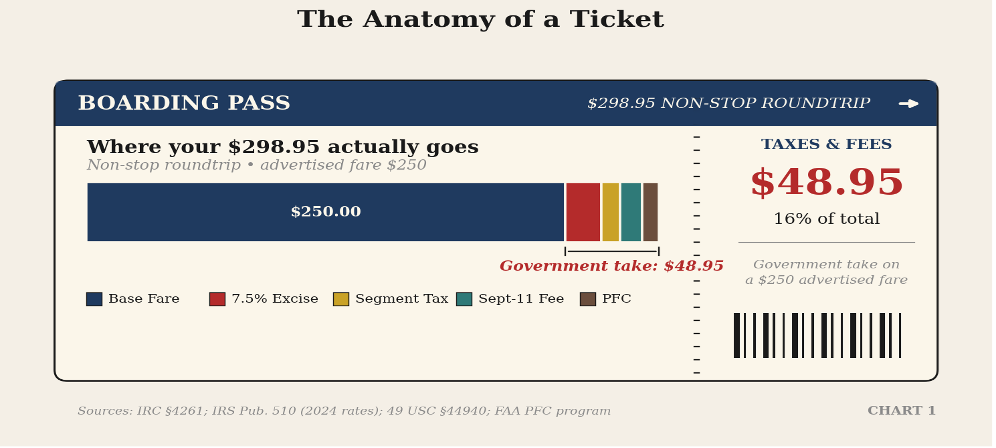
- About $50 of a $300 non-stop ticket is taxes and fees, not airline revenue. On connecting itineraries, government taxes and fees exceed 19% of the ticket price.
- The federal 7.5% excise tax applies only to fares, not ancillary fees. This tax distinction drove the growth of bag, seat, and boarding charges into a $148 billion global business.
- Airline loyalty programs (SkyMiles, MileagePlus, AAdvantage) have been valued higher than the airlines themselves. Flying has become a channel to sell miles to credit-card issuers.
- The four largest U.S. carriers earned $14 billion in 2024 operating profit. Nearly all of it came from credit-card partners (Amex, Chase, Citi, Barclays) purchasing miles; passenger operations approximated break-even.
- Spirit Airlines pioneered the unbundled fare model but never built a meaningful loyalty program. When labor and fuel costs rose, it had no secondary revenue stream to absorb the shock and became the first major U.S. airline to shut down in eighteen years.
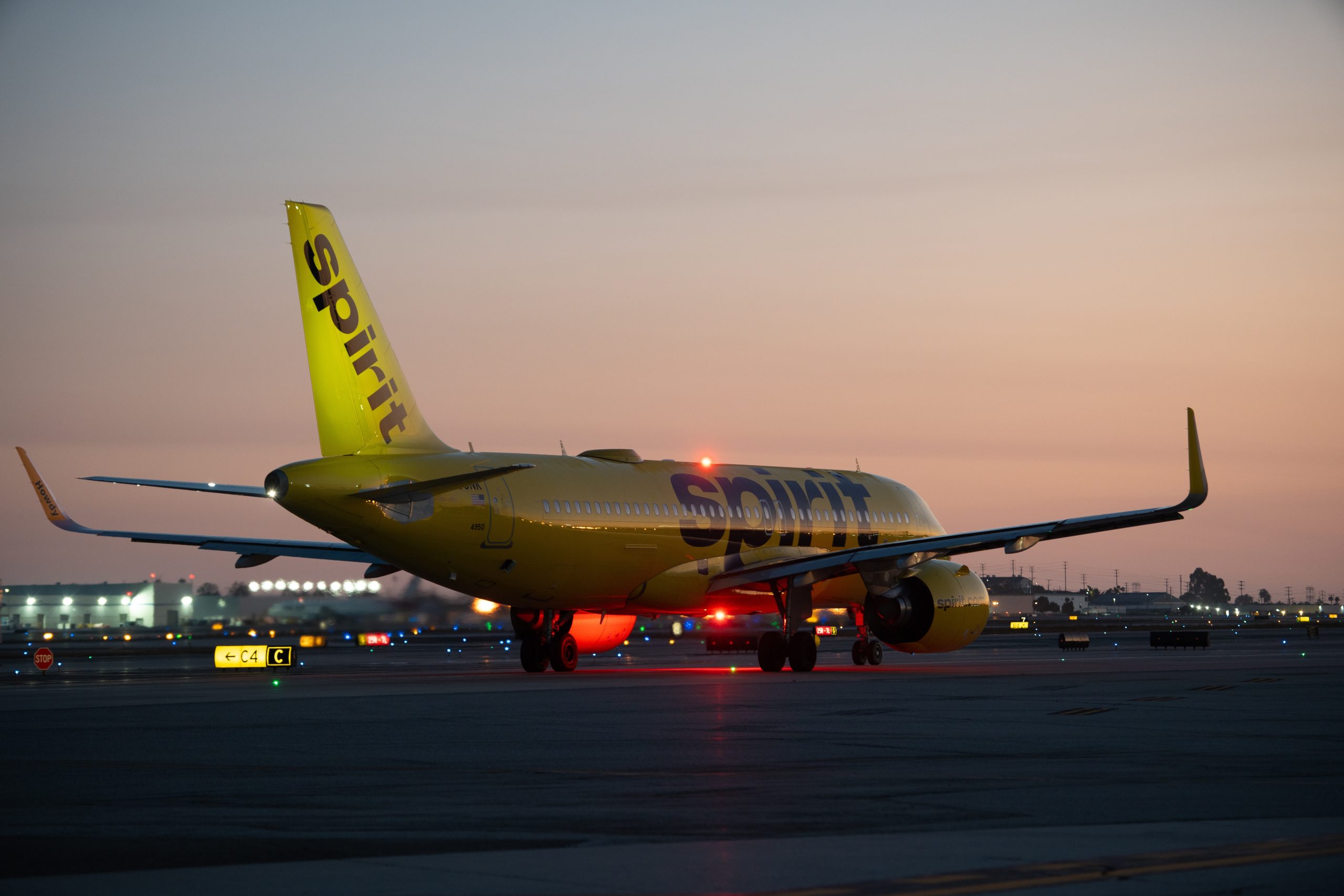
On Saturday, May 2, 2026, the last yellow Airbus taxied to the gate, and Spirit Airlines — 34 years old, 17,000 employees, no fatal accident in its history — went dark. A $500 million federal bailout had collapsed the night before. By Monday, the four largest U.S. carriers were rebooking 94,000 passengers and small airports across the country woke up without daily air service.
It is the first time a major U.S. airline has gone out of business since April 2008, when Aloha, ATA, and Skybus all collapsed in the same week. Eighteen years. And it happened in a year the industry made $14 billion in profit.
To understand why Spirit failed, you have to start with understanding what’s behind the price on the fare screen.
What’s hiding in a $300 ticket
Book a non-stop roundtrip from New York to Chicago for what the website calls $300, and roughly $50 of that money is not going to the airline. It is going to the federal government, the airport, and the TSA — a stack of five separate taxes and fees a traveler rarely sees itemized. On a connecting itinerary the government’s share climbs above 19%, because every additional segment triggers another tax and another airport fee.
That gap — between what the screen shows and what the airline keeps — is where Spirit was born.
The 7.5% loophole that built the ultra-low-cost airline
The loophole is a single paragraph of the tax code. Section 4261 imposes a 7.5% excise tax on “the amount paid for taxable transportation” — the fare. It does not apply to the checked bag, the seat assignment, the priority boarding, or the onboard meal. The IRS’s own audit guide is explicit: ancillary fees are exempt.
For an airline, the implication is irresistible. Every dollar reclassified from “fare” to “fee” avoids the tax. A 2024 Senate investigation found that on identical itineraries, the effective tax rate at ultra-low-cost carriers was less than half of what American or Delta passengers paid.
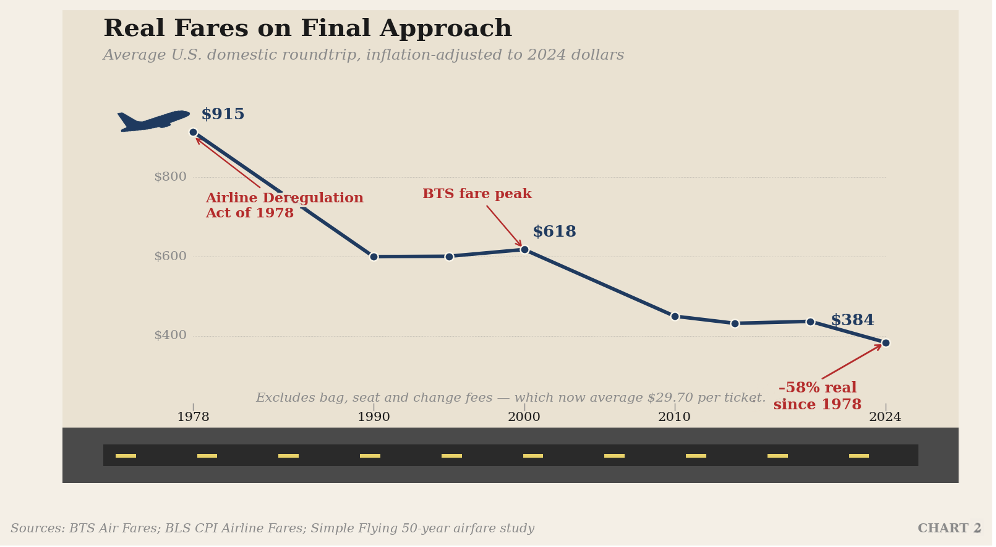
This is the business model — and Spirit walked through that door more aggressively than anyone. The average domestic round trip was $618 in 2000; in 2024 it was $384, a 37.8% decline in real terms. The trip got cheaper while the add-ons became more expensive. And Spirit’s $9 fares became famous precisely because so much of the actual cost had been moved off the fare screen.
How $15 became $148 billion
The unbundling era began in May 2008, when American Airlines became the first major U.S. carrier to charge $15 for a checked bag. Within eighteen months, every major airline except Southwest had followed.
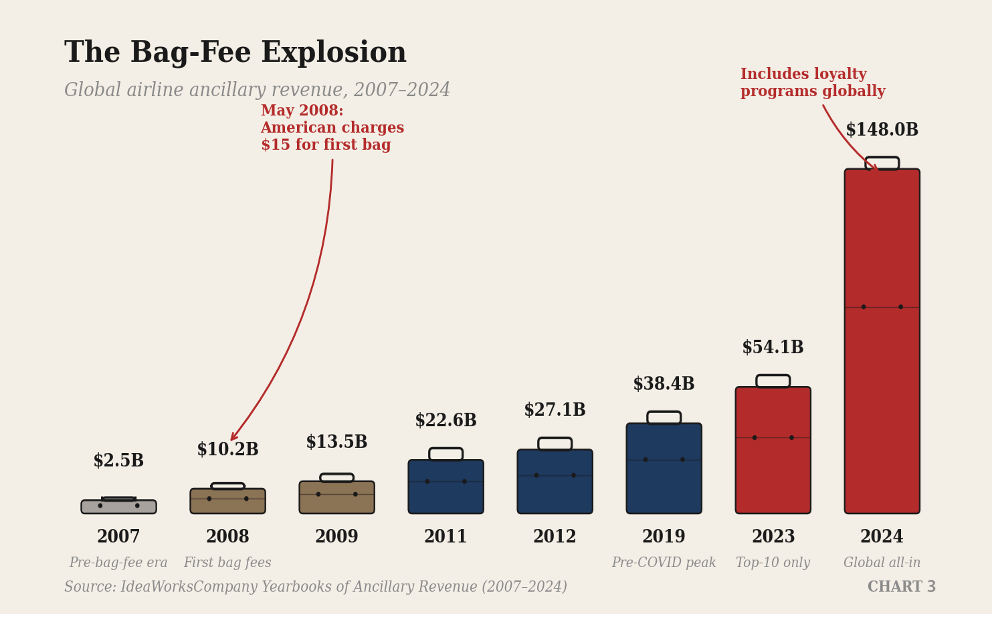
In 2007, the world’s airlines collectively reported $2.45 billion in ancillary revenue. By 2024, the figure had reached $148 billion globally. American invented the move. Spirit perfected it. By 2015, it had become one of the most profitable airlines by running this playbook — earning more on every dollar of revenue than American, on roughly a twentieth of American’s size. Almost half of Spirit’s revenue came from things that weren’t the ticket; at American, it was about a third.
That was the high-water mark. But the fee model only works if costs cooperate. Sometimes, they don’t.
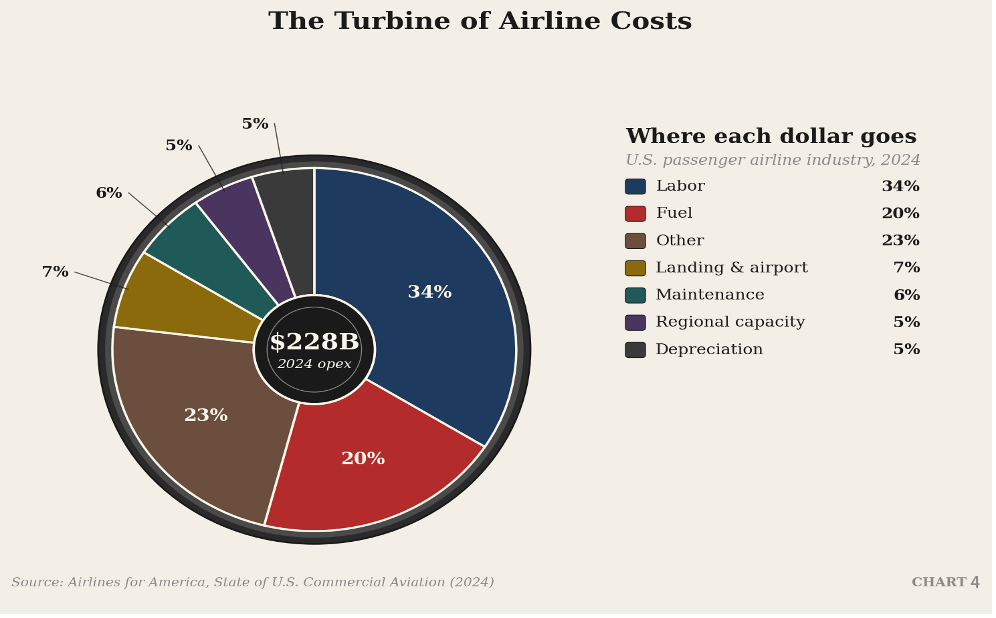
U.S. passenger airlines spent $228.1 billion in 2024. Labor is 34% of operating expenses and rising — post-pandemic contracts pushed labor’s share of revenue from 26% in 2005 to 33% today. Fuel is 20%. Aircraft ownership, the line item the imagination assumes is largest, is only about 10%.
This is where Spirit’s model began to unravel. The fee ceiling has a limit — passengers will only tolerate so many add-ons — but costs began to rise at Spirit. Industry wage increases and defective aircraft led Spirit to match a 34% pilot pay hike and ground a chunk of its fleet, bringing a deficit that its operating model couldn’t absorb.
The result: between 2019 and 2024, Spirit’s costs rose 40% while its revenue rose only 8%. By 2024, it was spending more than it earned on every seat it flew. And in this business, margins only get tighter.
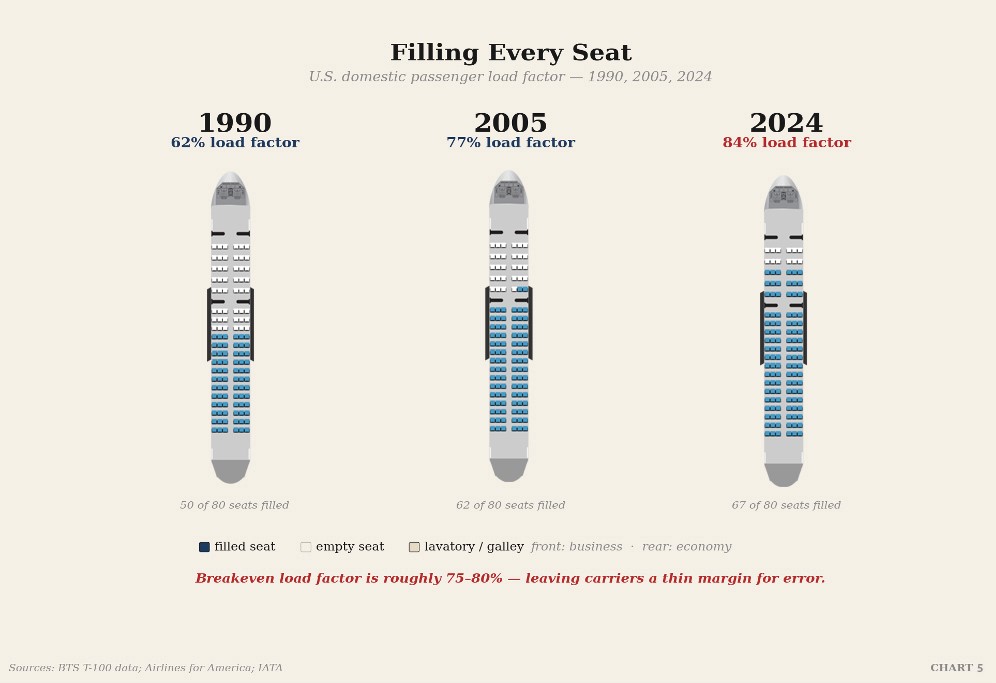
A passenger load factor of 84% — the U.S. average in 2024 — would have looked like a scheduling error in 1990, when the typical flight went out 62% full. Most legacy carriers now need to fill 75–80% of seats just to cover costs. The gap between profitable and unprofitable is roughly seven percentage points — on a 180-seat aircraft, that’s twelve passengers.
CASM (cost per available seat mile) measures how much it costs an airline to fly one seat one mile. Delta’s 2024 CASM was 19.3¢ against 21.4¢ revenue per seat mile—a 2¢ margin. Spirit’s 2023 CASM was lower at 10.5¢, but revenue was just 9.6¢—a penny underwater. The entire airline business lives or dies on that gap. The gap is tiny.
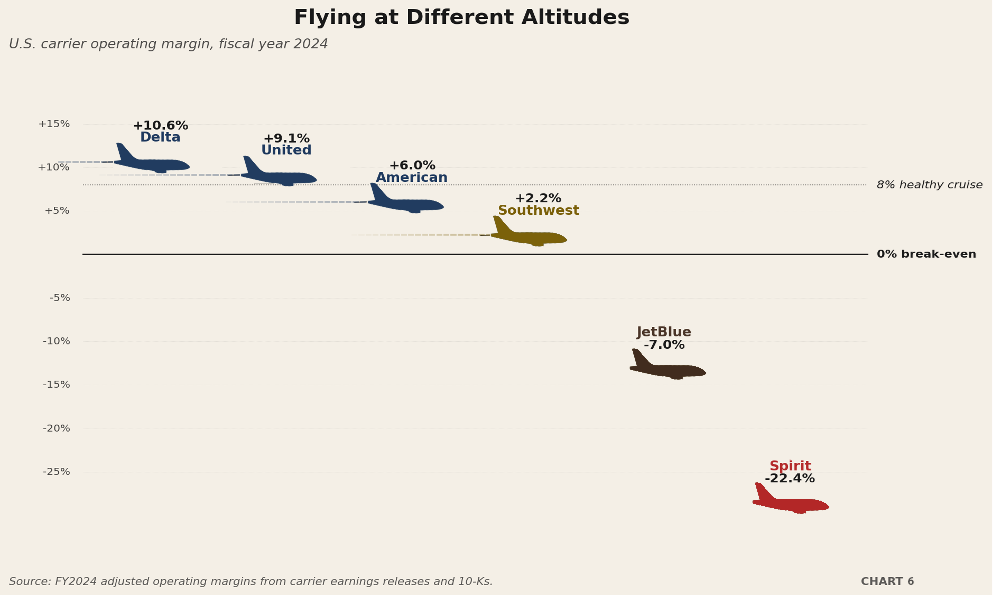
2024 margins across airlines paints quite a spread: Delta at 10.6%, United at 9.1%, American at 6.0% (all adjusted), Southwest at roughly 2%, JetBlue at negative 7%, and Spirit at negative 22.4%.
So how does the airline that was beating everyone nosedive into losing 22% on every dollar while its competitors stay aloft?
The answer lies not in the planes they fly, but in the cards they swipe.
The program is worth more than the airline
In September 2020, with passenger revenue in freefall, Delta borrowed $9 billion against SkyMiles, its branded American Express credit card. United had pledged $6.8 billion against MileagePlus three months earlier. American upsized an offering against AAdvantage to $10 billion.
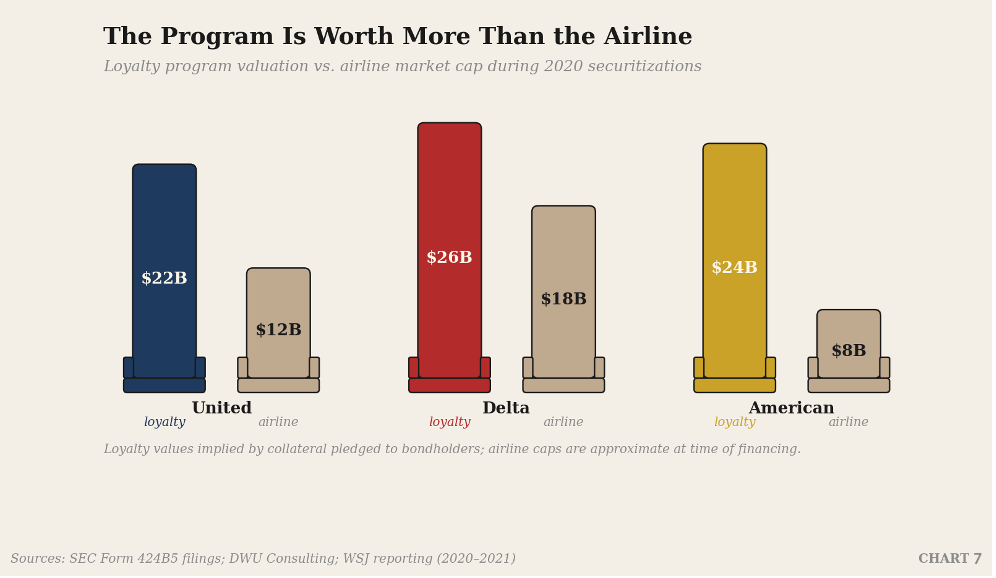
United’s entire market cap that summer was $10–15 billion; MileagePlus, a subsidiary, had been valued at over $22 billion. Delta’s SkyMiles sat at $26 billion against an airline cap of $18 billion. American’s AAdvantage was worth roughly three times the airline.
The cash those programs generate is extraordinary. In Q1 2025, Amex paid Delta $2.1 billion for miles — Delta’s entire operating profit that quarter. Across the four largest U.S. carriers, almost all of 2024’s $14 billion in operating profit came from credit-card issuers buying miles. The flying business, on its own, broke even.
Spirit had a frequent-flyer program, but almost nobody used it. There were no SkyMiles, no Amex check, no second engine. When the fee model stopped covering the bills, there was nothing to glide on.
What killed Spirit
Spirit died because the modern airline business stopped being about selling seats. The legacies figured that out and built loyalty programs worth more than their planes. Spirit doubled down on selling seats — cheaper, more unbundled, more profitably than anyone had ever managed — and for a while it worked beautifully. Then labor got expensive, fuel got expensive, and the fee ceiling held. The airline filed for bankruptcy in November 2024, restructured, filed again, and on May 2, 2026, ran out of fuel.
The shock isn’t just that an airline failed, it’s that no major U.S. carrier had failed in eighteen years, that this one died at a moment of industry-record profits. And the playbook it pioneered — moving revenue from the fare screen to the fee column — is now used by every airline that survived it.
Sources
Primary data and reporting drawn from:
- Airlines for America — U.S. Government-Imposed Taxes on Air Transportation
- Airlines for America — State of U.S. Commercial Aviation (2024)
- Internal Revenue Code §4261
- IRS Excise Tax Audit Techniques Guide — Air Transportation
- Senate PSI — “The Sky’s the Limit: The Rise of Junk Fees in American Travel” (Nov. 2024)
- BTS — 2024 Annual Average Domestic Air Fare
- IdeaWorksCompany — Yearbook of Ancillary Revenue (2024)
- Delta Air Lines 2024 10-K
- Delta Q4 2024 results
- Spirit Airlines 2023 10-K
- PBS — Spirit Airlines goes out of business after 34 years
- Cranky Flier — April 2008 airline shutdowns
- DWU Consulting — Airline Loyalty Program Securitization
- IATA — Specific Taxes on the Use of Air Transport (2024)
- Executive Travel — $148 billion in ancillary fees
- Forbes — Breaking Down Taxes On Airline Tickets
This material has been prepared for informational purposes only, and is not intended to provide or be relied upon for legal or tax advice. If you have any specific legal or tax questions regarding this content or related issues, please consult with your professional legal or tax advisor.